
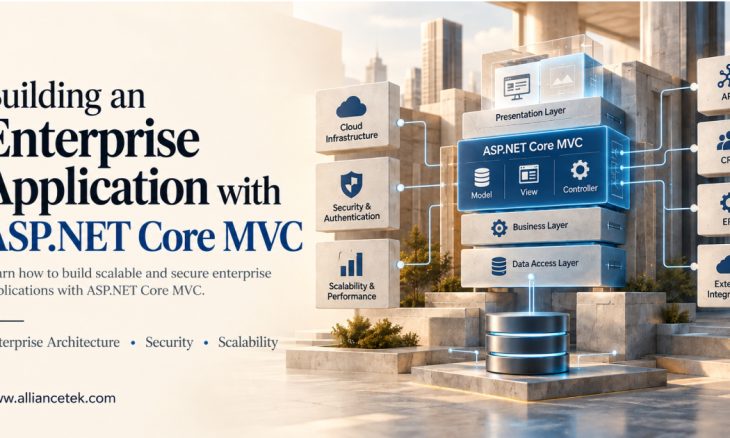
Enterprise applications need to support complex business processes, large user bases, multiple integrations, and long-term growth. They also need to provide strong security, reliable performance, and maintainable architecture.
ASP.NET Core MVC provides a modern framework for building web applications that can meet these requirements. Its modular architecture, cross-platform capabilities, dependency injection, middleware pipeline, and integration with the broader .NET ecosystem make it suitable for enterprise application development.
For organizations building new business applications or modernizing existing systems, ASP.NET Core MVC can provide a structured foundation for developing scalable and secure web solutions.
What Is ASP.NET Core MVC?
ASP.NET Core MVC is a web development framework within the .NET ecosystem. It uses the Model-View-Controller architectural pattern to separate application responsibilities.
The three main components are:
- Model: Represents business data and application logic.
- View: Handles the user interface presented to users.
- Controller: Processes requests and coordinates application behavior.
This separation makes applications easier to organize, test, maintain, and expand as business requirements evolve.
ASP.NET Core is also cross-platform, allowing applications to run on Windows, Linux, and macOS environments.
Why Use ASP.NET Core MVC for Enterprise Applications?
Enterprise applications typically have requirements that go beyond basic web development. They may need role-based access, complex workflows, database integrations, APIs, reporting, third-party services, and cloud infrastructure.
ASP.NET Core MVC provides capabilities that can support these requirements.
Scalable Architecture
Enterprise applications need an architecture that can evolve as the organization grows.
ASP.NET Core supports modular application design, allowing development teams to separate functionality into logical components. Teams can also use architectural approaches such as layered architecture, clean architecture, or domain-driven design depending on project requirements.
A well-structured architecture makes it easier to add new functionality without creating unnecessary dependencies across the application.
Built-In Dependency Injection
Dependency injection is built into ASP.NET Core.
It allows developers to separate application components from their dependencies, which can improve maintainability and testability.
For enterprise applications, dependency injection can be used for services such as:
- Database repositories
- Business services
- Logging
- Authentication services
- External API clients
- Caching
- Application integrations
This makes it easier to replace or test individual components as the application evolves.
Strong Security Capabilities
Security is a critical requirement for enterprise applications because they may handle sensitive business and customer information.
ASP.NET Core supports authentication and authorization mechanisms that can be integrated with enterprise identity systems.
Applications can implement:
- Role-based authorization
- Claims-based authorization
- Identity management
- Secure authentication
- HTTPS
- Data protection
- API authentication
- Access controls
Security should be considered throughout the application architecture rather than added only after development is complete.
Designing the Architecture
Before development begins, organizations should define the application’s architecture based on business requirements.
A common enterprise application architecture can include:
Presentation Layer → Application Layer → Business Layer → Data Access Layer → Database
Additional services can be integrated through APIs, messaging systems, cloud services, and external platforms.
Separating these responsibilities helps development teams maintain the application as it becomes larger and more complex.
For particularly large applications, teams may also consider modular monolith or microservices architectures depending on scalability and deployment requirements.
Database Integration
Enterprise applications often depend on relational databases for storing business data.
ASP.NET Core applications can integrate with databases using technologies such as Entity Framework Core. Developers can use an object-relational mapping approach to work with database entities through .NET code.
A well-designed data layer should consider:
- Database performance
- Indexing
- Transactions
- Data validation
- Connection management
- Migration strategies
- Backup and recovery
- Data security
Database architecture should be designed alongside the application’s business requirements rather than treated as a separate consideration.
Building APIs with ASP.NET Core
Enterprise applications frequently need to communicate with other applications and services.
ASP.NET Core can be used to build REST API solutions that connect web applications, mobile applications, third-party platforms, and internal business systems.
For example, an enterprise application might integrate with:
- CRM platforms
- ERP systems
- Payment services
- Microsoft 365
- Salesforce
- Business intelligence platforms
- Mobile applications
- Cloud services
A well-designed API layer can help organizations connect systems without tightly coupling every application component.
Performance and Scalability
Enterprise applications may need to support thousands or even millions of requests depending on the business.
ASP.NET Core is designed for high-performance web workloads and provides several options for improving application performance.
Development teams can consider:
- Asynchronous programming
- Response caching
- Distributed caching
- Database optimization
- Efficient API design
- Load balancing
- Horizontal scaling
- Cloud-based infrastructure
Performance testing should be conducted before production deployment to identify bottlenecks and understand how the application behaves under expected workloads.
Enterprise Application Deployment
ASP.NET Core applications can be deployed across different environments depending on business requirements.
Organizations can deploy applications on:
- Microsoft Azure
- AWS
- Private cloud infrastructure
- On-premises servers
- Linux environments
- Windows environments
- Containerized infrastructure
Cloud deployment can also support automated scaling, monitoring, logging, and continuous delivery.
Development teams should establish separate development, testing, staging, and production environments to reduce deployment risks.
Testing and Monitoring
Testing is essential for enterprise applications because application failures can affect business operations.
Teams can implement different testing approaches, including:
- Unit testing
- Integration testing
- API testing
- Security testing
- Performance testing
- User acceptance testing
Monitoring should continue after deployment. Application logs, performance metrics, errors, infrastructure health, and user activity can provide valuable information for maintaining application reliability.
Modernizing Existing .NET Applications
ASP.NET Core MVC can also be part of a modernization strategy.
Organizations with legacy .NET applications may gradually modernize their systems rather than replacing everything at once. Developers can identify high-value modules, expose existing functionality through APIs, migrate selected components, and progressively introduce modern architecture.
This approach can reduce migration risk while allowing organizations to improve application maintainability and scalability over time.
Best Practices for Enterprise ASP.NET Core MVC Development
Successful enterprise development requires more than selecting a framework. Development teams should establish practices that support long-term application quality.
Key considerations include:
- Define architecture before development
- Separate business logic from presentation logic
- Apply dependency injection consistently
- Implement centralized logging and monitoring
- Follow secure coding practices
- Optimize database queries
- Build reusable APIs and services
- Automate testing and deployment
- Document critical application components
- Plan for scalability from the beginning
These practices can help organizations build applications that remain maintainable as requirements and user demands change.
Conclusion
ASP.NET Core MVC provides a flexible foundation for building enterprise web applications that require scalability, security, performance, and maintainability. Its architecture and integration with the broader .NET ecosystem make it suitable for applications ranging from internal business platforms to customer-facing enterprise solutions.
However, the framework is only one part of a successful enterprise application. Architecture, database design, security, integrations, testing, deployment, and ongoing maintenance all influence the long-term success of the solution.
